
One of the most emotional and life-changing conversations many couples will ever have happens before marriage – or before starting a family.
It often begins with a simple question:
“We both carry the trait… does that mean we can never have healthy children?”
For many couples, especially in countries like Nigeria where genotype compatibility is a major public health conversation, this question carries deep emotional weight. It can affect relationships, marriage decisions, family expectations, and future dreams.
The good news is this: Yes, two carriers can have healthy children.
But understanding what that truly means – and what risks, options, and responsibilities come with that reality – is incredibly important.
At Funmilola Sickle Cell Foundation, one of the things we stand for is helping individuals and families make informed health decisions through awareness, education, support, and advocacy around Sickle Cell Disease.
If you or your partner are carriers, this guide will help you understand exactly what you need to know before making family planning decisions.
First, What Does It Mean to Be a Carrier?
A carrier is someone who has inherited one normal gene and one altered gene linked to a genetic condition.
In the case of Sickle Cell Disease, carriers often have what is commonly known as sickle cell trait.
This means:
- You usually live a normal, healthy life.
- You may never show signs or symptoms.
- Many carriers don’t even know they carry the trait until they undergo genotype testing.
Being a carrier does not mean you are sick.
However, it does mean you can pass the gene to your children.
That’s why genotype awareness is so important.
Can Two Carriers Have Healthy Children?
Yes – absolutely.
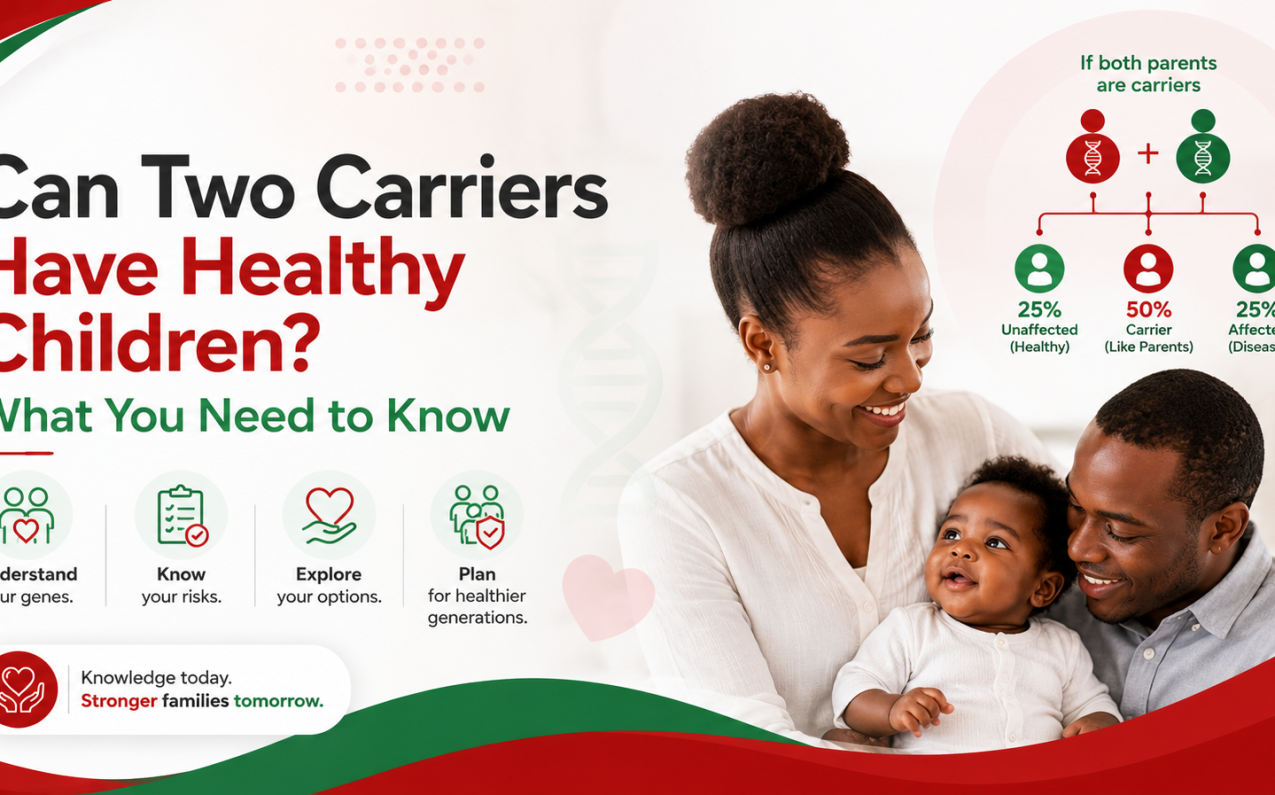
If two carriers of the same recessive condition have a child together, each pregnancy carries certain genetic possibilities.
Here’s what science tells us:
For every pregnancy:
There is:
- 25% chance the child inherits two normal genes
(the child is completely unaffected) - 50% chance the child inherits one normal gene and one altered gene
(the child becomes a carrier, like the parents) - 25% chance the child inherits two altered genes
(the child develops the disease)
This means 3 out of 4 possible outcomes do not result in the child having the disease.
That said, 1 out of 4 is still a real risk, and families should never ignore it.
Understanding the Genetics in Simple Terms
Imagine four possible outcomes every time pregnancy occurs.
Each pregnancy creates a new combination.
This is important because many couples wrongly assume:
“Our first child is healthy, so the next children will also be fine.”
That’s not how genetics works.
Each pregnancy is an entirely independent event.
So even if:
- Your first child is unaffected,
- Your second child is a carrier,
your third pregnancy still carries the same risk.
The probability resets each time.
This is one of the biggest misconceptions many couples have.
Does This Only Apply to Sickle Cell?
No.
This same inheritance pattern applies to several inherited conditions, including:
- Sickle Cell Disease
- Cystic Fibrosis
- Tay-Sachs Disease
However, in Nigeria and many parts of Africa, sickle cell remains one of the most commonly discussed inherited conditions because of its high prevalence.
That is why organizations like Funmilola Sickle Cell Foundation continue to invest in public awareness and community education.
Why Genotype Testing Before Marriage Matters
One of the most painful realities many families face is discovering genotype incompatibility after emotional commitment – or worse, after marriage.
A simple genotype test can prevent years of emotional stress, confusion, and difficult family decisions.
Genotype testing helps couples:
1. Know their compatibility early
Instead of guessing, couples get clarity.
2. Make informed relationship decisions
Knowledge gives people the power to decide wisely.
3. Prepare emotionally and medically
If both partners are carriers, they can explore options early.
At Funmilola Sickle Cell Foundation, genotype education is one of the core pillars of our mission because prevention starts with awareness.
What If Both Partners Are Carriers?
If both partners carry the sickle cell trait, it doesn’t automatically mean they cannot have children.
But it does mean they need to approach family planning responsibly.
Here are important next steps:
1. Speak With a Genetic Counselor
A genetic counselor can help explain:
- Your exact genetic risks
- Your reproductive options
- Testing possibilities
- Emotional and medical considerations
Many couples feel fear simply because they don’t understand the science.
Education often replaces fear with clarity.
2. Explore Preconception Screening
Before pregnancy, additional testing can confirm:
- Your genotype
- Other possible inherited risks
- Family history concerns
This is especially important if there is already a history of Sickle Cell Disease in the family.
3. Understand IVF and Genetic Testing Options
Some couples choose assisted reproductive options.
In Vitro Fertilization (IVF)
IVF allows eggs and sperm to be fertilized outside the body.
Preimplantation Genetic Diagnosis (PGD)
This allows doctors to test embryos before implantation to identify those not affected by the condition.
For some families, this offers peace of mind.
Though access and affordability vary, awareness of these options matters.
What If You Are Already Pregnant?
If a couple discovers they are both carriers after conception, prenatal testing may still provide important answers.
Doctors may recommend:
Chorionic Villus Sampling (CVS)
Usually done early in pregnancy.
Amniocentesis
Usually done later in pregnancy.
These tests can help determine whether the baby is affected.
This information allows parents and healthcare professionals to prepare early.
Emotional Challenges Couples Often Face
Genotype conversations are not just medical.
They’re deeply emotional.
Couples may experience:
- Fear
- Guilt
- Relationship tension
- Family pressure
- Cultural misunderstandings
Some even blame themselves.
But being a carrier is not something anyone chooses.
What matters is what you do with the knowledge.
At Funmilola Sickle Cell Foundation, we believe families deserve compassion – not judgment.
Common Myths About Carriers
Myth 1: Two carriers can never have healthy children
False.
As explained earlier, two carriers can absolutely have healthy children.
Myth 2: If one child is healthy, all others will be
False.
Each pregnancy carries its own independent probability.
Myth 3: Sickle cell only affects Africans
False.
Sickle Cell Disease affects people across different races and ethnic backgrounds.
Myth 4: Carriers are sick
False.
Most carriers live healthy lives and may never experience symptoms.
Practical Tips for Couples
If you and your partner are carriers, here are practical steps to take:
Get tested early
Don’t wait until wedding plans are finalized.
Ask questions
Never make life-changing decisions based on assumptions.
Involve professionals
Doctors, hematologists, and genetic counselors can guide you.
Educate your families
Sometimes extended family pressure comes from lack of knowledge.
Think long-term
Marriage decisions affect future generations.
Why Community Awareness Matters
Many cases of sickle cell complications could be reduced through:
- Early genotype testing
- Better public education
- Access to counseling
- Family support systems
This is exactly why Funmilola Sickle Cell Foundation exists.
We are committed to:
- Educating communities
- Supporting families
- Raising awareness
- Offering hope to those affected by Sickle Cell Disease
Because every informed decision has the power to save lives.
Final Thoughts
So, can two carriers have healthy children?
The answer is yes.
But the better question is:
Are you informed enough to make the right decisions for your future family?
Knowledge changes everything.
Testing creates clarity.
Counseling brings confidence.
And awareness saves lives.
At Funmilola Sickle Cell Foundation, we remain committed to helping families make informed choices, protect future generations, and build stronger communities.
Because when families understand sickle cell, hope becomes possible.